
NO INDEX
Open PDF
Loading flipbook...
1 / 1
Ready
20,00 €
In stock
20,00 €
In stock
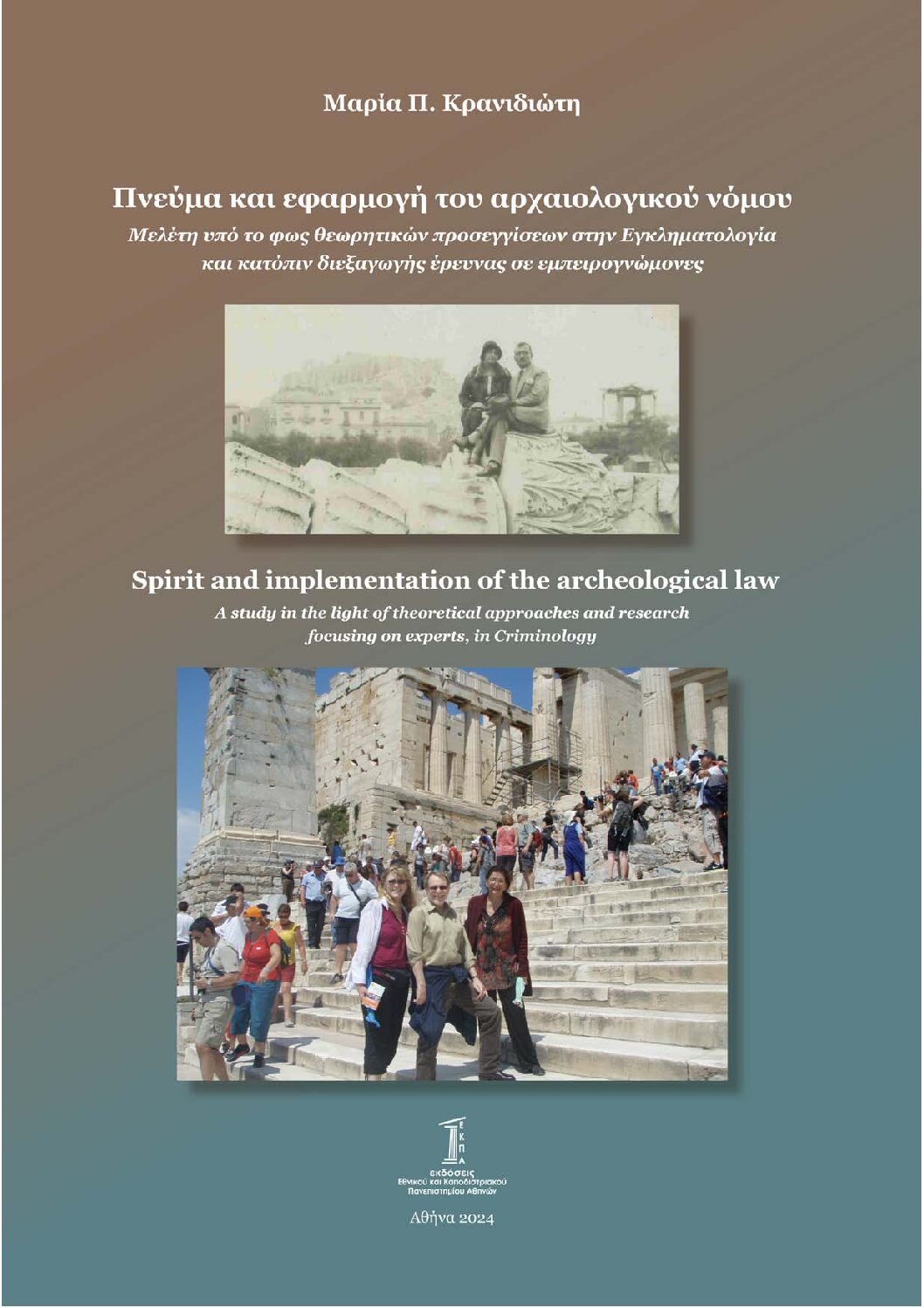
The book addresses the spirit and application of archaeological law, from the perspective of Criminology as a field of study, primarily in its narrow sense (the etiology & interpretation of criminal phenomena and methods of their investigation). Chapter one presents theoretical approaches and subsequent research in Criminology, concerning the phenomena of illicit trafficking and collection of cultural goods. These approaches include the theory of global anomie, routine activities, and deterrence, Sykes and Matza’s perspective on “techniques of neutralization” (particularly arguments), as well as Campbell’s criminological “network paradigm”. Chapter two analyzes archaeological law, primarily based on the rationale presented in its Explanatory Report. Specifically, it examines issues such as the definitions of monuments and cultural goods and the values they embody, the determination of the “subject of ownership” of cultural heritage (national/global), and the multidimensional concept of its protection. Furthermore, it examines the criminal offenses included in archaeological law, in relation to other penal provisions and previous legislation, as well as the role of auditing bodies and prosecuting authorities. Finally, it examines international texts and their application concerning the illicit trafficking and collection of cultural goods. Chapter three thoroughly describes the research design, which was conducted using a semi-structured questionnaire with a sample of experts (primarily archaeologists). Chapters four and five present the initial analysis and interpretation of the data obtained from the research, focusing on the general concept of protection within archaeological law, and specifically on its criminal provisions and the approach to antiquities smuggling. Finally, chapter six, the concluding chapter, includes the second analysis and synthetic interpretation of the entire dataset, the conclusions, and the author’s final thoughts. The study is accompanied by a) an appendix and b) an index of terms/keywords.
Maria P. Kranidioti graduated from Hill School (Hill Memorial School 1831), received her degree from the Law School of the National and Kapodistrian University of Athens (NKUA) in 1978, and subsequently, her Master of Arts in Criminology from the University of Hull, U.K. (1981). In 1993, she was awarded a doctorate from the Law School of NKUA (with distinction). She served as a scientific associate and a member of the Teaching and Research Staff of the Department of Criminal Sciences, Law School of NKUA, for over 40 years (retirement: August 31, 2022, as Associate Professor). She taught for many years in undergraduate courses of the Department of Criminal Sciences, as well as the Erasmus program, in Greece and abroad (Criminology, Penology, International Criminal Law, Criminology-Criminal Justice), and at postgraduate level, mainly in the courses "Theoretical Criminology" (independent teaching: 1996-2021) and "Methodology of Criminology." She has participated in many research programs (e.g.): Guarding Museums and Archaeological Sites in Greece: Offenses and Protection of Cultural Heritage, 1999-2013: Scientific Coordinator of the Project (funding: Special Account for Research Funds (ELKE) of NKUA). Tricountry Survey, 2006-2016: Development of a research plan and questionnaire construction (jointly with Charles R. Tittle, Olena Antonaccio, and Ekaterina V. Bothchkovar) & conduct of the research in Greece (funding: North Carolina State University, USA). She has also served as a reviewer for scientific journals, President and member of many scientific committees (such as President of the Selection Committee for Postgraduate Scholars of the Maria Stai Foundation), a member of the Secondary Committee for the Recruitment of Special Scientific Staff (Financial Crime Unit) of ASEP, and a regular member of the Central Scientific Council of Prisons (KESF) of the Ministry of Justice. She has authored four scientific monographs, more than forty studies, and has also prefaced studies and edited and translated scientific works by other authors from English to Greek and vice versa. Her written work focuses particularly on the interplay between theory and research (e.g.): Maria P. Kranidioti, The Integration. A Method for Theory Development in Criminology, Nomiki Vivliothiki Publications, Athens 2007.
Tel. Call Center +30 210 3688 189
Operating Hours Mon-Fri: 10:00 - 17:00
Tel. Call Center +30 210 3688 189
Operating Hours Mon-Fri: 10:00 - 17:00
Tel. Call Center +30 210 3688 189
Operating Hours Mon-Fri: 10:00 - 17:00